Showing posts with label preprint. Show all posts

Saturday, October 31, 2015

bioRxiv vs. arXiv

If you've been reading along since the beginning, you'll know that I'm a huge #openaccess fan, and, really, am something of an oversharer. When I began my scientific career, I was posting all of my work on the qBio section of the arXiv. Me and some colleagues responded to the increase in utilisation of #preprint servers by making Warburg's Lens, a blog inspired by Haldane's Sieve to help aggregate mathematical oncology pre-prints, and allow for discussion. We've had a ton of success with Warburg's Lens, and it has been helpful for many folks. One of the nice aspects of it, that the arXiv didn't have, was the ability to comment, and to link in to social media in general.

A couple years ago, Richard Sever contacted me about an upcoming project, the bioRxiv, and asked me to be an affiliate - which I eagerly accepted. It seemed the perfect way to help convince my more open minded biological colleagues - something to which there are still quite a few (unsubstantiated) barriers.

This past summer, at the annual Society for Mathematical Biology Meeting, I gave a talk on pre-print servers and social media in science. While I was preparing for the talk, I ran across a great infographic about the arXiv and was blown away how LITTLE qBio there actually is... (something like 1.6% - TONS MORE info here)


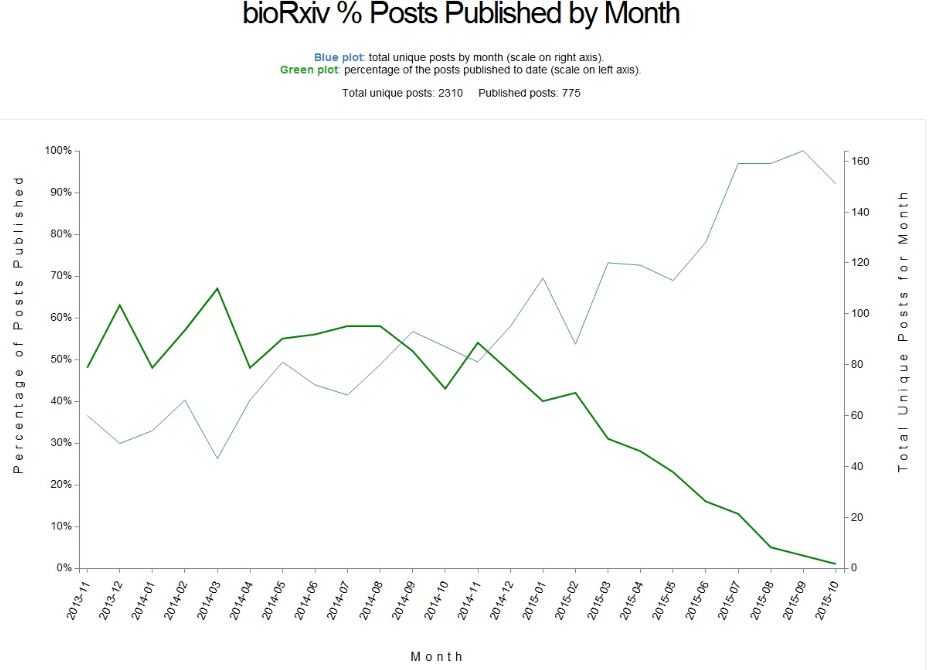
Anyways, I recently asked Richard if there were any stats on publications/utilization of the bioRxiv. At the time, there were no stats done, but today I saw on this twitter:


Within just a year, more than half have been published!  Good news. I'm hoping that my newest preprint (which is also on Warburgs Lens here) joins the majority ASAP :)

Anyways, I'm heartened to see the increase in utilisation.  I have to say, having submitted I think 6 manuscripts to the bioRxiv, and around the same number to the arXiv, the process at the bioRxiv is MUCH easier. It can be done in minutes, rather than fighting with the LaTeX compiler on the arXiv istelf. My current practice is to send everything to the bioRxiv, though I still read and monitor the qBio section of the arXiv... what are your practices?


Saturday, August 2, 2014

Re-entry into the clinic and my first evolution paper!

Sorry for the long radio silence - I re-entered my residency after a 3 year hiatus to pursue full time research and things have been busier than anticipated. While I am on a light rotation (sarcoma), which requires only 50% of my time actually in clinic, I had forgotten what being a #resident is like, and more importantly, what having a pager is like!!!

My personal research efforts have slowed somewhat - with my efforts now divided between the clinic, being a dad and thesis writing. I've changed my focus to writing up what I have currently, rather than chasing after new results, so I haven't much to report. A student I'm working with, however, +Daniel Nichol , recently finished up a paper that he and I have been working on for some time. He is going to write a full blog post about the work, but this will take some time. In the mean time, I thought I'd at least let the community know we've finally submitted our paper to the +bioRxiv Preprints site, as well as a journal (contemporaneously), which you can find here:

http://www.biorxiv.org/content/early/2014/08/03/007542


In this paper, my first personal foray in theoretical #evolution we build on theory from some exciting theoretical and experimental papers from Steven Weinreich (Weinreich et al. Science) and +Jeff Gore (Tan et al. PRL) to explore the concept of 'steering' evolution as a method of preventing the emergence of resistant strains of bacteria (or cancer!).

I look forward to putting Dan's proper post up, but until then, enjoy the #preprint - we welcome comments!

We were flattered, as well, to see another blog pick up our preprint - yet another reason to use the bioRxiv or arXiv!

Sunday, May 25, 2014

A success story for Warburg's Lens

I've been travelling a lot of late, which I'll blog about on its own in a bit (including a 'best of the best' coffee machines post), but I heard a story from a friend, which triggered a memory which I want to share. It took a moment, but I realised that a whole chain of events that I was unaware of, yet intimately involved in) added up to a success story for Warburg's Lens, the theoretical oncology preprint discussion forum that some colleagues and I started to try to speed up the process of scientific discussion.

So the story goes like this:

I was trolling the qBio section of the arXiv, as you do on a Friday night, looking for interesting papers. For the record, I also always scan the +bioRxiv Preprints. On this night, I came across one from one of my favorite authors, +Arne Traulsen, who has an evolutionary theory group at the Max Planck Institute in Plon, Germany. The #preprint, entitled, Cancer initiation with epistatic interactions between driver and passenger mutations, seemed like a very interesting one, so I put it on Warburg's Lens for discussion. It generated some nice discussion on the site which even included the authors, who were able to defend some of the points, but also take on board some very relevant (non-anonymous) feedback.


Fast forward a bit, and I'm minding my own business trying to get a job, and I get a request from a journal to review an article.... lo and behold it is the same one we are talking about. For various reasons, I declined to review it, but I remembered that there were some very constructive criticisms from people on Warburg's Lens (people who have published significant works in this direct area), so I knew who I could suggest as a replacement reviewer, which I did. Readers won't have a problem guessing who any of the anonymous people are, but I will not divulge that here.

Fast forward again, and I'm visiting some colleagues in Boston (again, post to follow, there was wide #heterogeneity in coffee machines) and a friend mentioned that this great paper that he had reviewed just came out...  and on the same day, my colleague and supervisor, +Alex Fletcher sent me an email notifying me of the paper, which is now out, and you can find it online here, but of course, I can't get it at home without dropping $40. I am eager to read the paper and compare it to the #preprint.


Either way, congrats to +Arne Traulsen et al. on the nice paper and thanks to all who contribute to the discussion on Warburg's Lens - and it's inspiration website, Haldane's Sieve. Keep submitting your #preprints to repositories like the arXiv and +bioRxiv Preprints, keep doing good #openscience. This seems like a win for everyone.

Also, lest I forget, cheers to the Journal of Theoretical Biology for being cool with preprints. Let's keep adding to the list.  This is a tangible example of how preprint servers help EVERYONE, even the journals. We got faster, more on target review, because of the preprint. A list of journals and their preprint policies can be found here:

http://en.wikipedia.org/wiki/List_of_academic_journals_by_preprint_policy

Monday, December 9, 2013

Guest post on the Oxford Centre for Maths Biology Blog

I wrote a post for my group's new blog on the importance of #preprints in science, and specifically on the new #bioRxiv.  Head on over and check it out:

http://wcmb-oxford.blogspot.com/2013/12/pre-print-servers-dangerous-ways-to.html

Thursday, December 5, 2013

Investigating the effects of microenvironmental perturbation on a stem driven tumor

I've been interested in the cancer stem cell hypothesis for some time, a subject that my colleague +Heiko Enderling has been thinking about and modeling for some time (list of his pubs here). I first became interested in this concept before I became a DPhil student and member of the Integrated Mathematical Oncology group, when I was a clinical resident in radiation oncology at the Moffitt Cancer Center.  One of the first papers that I saw that truly scared me was a paper by Tamura and colleagues (abstract) that showed that recurrent glioblastomas had a significant increase in CD-133 staining (a stain commonly associated with stemness in this cancer and others), and that this increase is correlated with (maybe causes, jury yet out) an increase in aggressiveness of the recurrent tumor and a decrease in its sensitivity to treatment.


The standard rationale for the latter is that these special 'stem cells' have a higher intrinsic resistance to radiation therapy (which I don't argue), but I subsequently wrote down a series of simple (some might say Noddy) ODE models which suggested, at least to me, that there might also be a stem promoting effect of radiation.  Since then, I have found that this effect has been shown in breast cancer, and further, that there have been a number of microenvironmental perturbations that have been shown to do the same thing, though only in a qualitative way - many of these articles have had my collaborator, +Anita Hjelmeland as a co-author, and I talked about them quite a bit in a previous blog post on our recent R-01 submission.

When I first started on this problem from the theoretical standpoint, it was with ODE models, as I mentioned.  But since then, +David Basanta and +Alexander Anderson and I have worked to build a cellular automaton model of a stem-driven tumor which included blood vessels as sources of oxygen. We built this simple model to test if there were some sort of intrinsic/emergent change in the resultant tissue phenotype when the overall levels of oxygen supplied to it went down (when we reduced the density of the vessels).  Below you can see the schematic of our model system.  On the left is the canonical Cancer Stem Cell hypothesis (which I have major issues with...  more to come in a few weeks I hope) and on the right there is our CA model rules.


After much simulation and effort we found... in short, that no, there is not. Our initial, negative results, were frustrating, but after discussions with +Anita Hjelmeland and Prakash Chinnaiyan (a biologist and clinician, respectively) we found that the model was telling us more...  while we found little qualitative effect when we changed the vascular density, changing the instrinsic stem behavior parameters in the presence of a minimalistic environment revealed that there were only three major meta-phentypic behaviors possible: extinction, dormancy (homeostasis) and overgrowth as seen below.


Our frustration at not seeing the emergence of greater stem-fraction upon lowering the oxygen levels however, led to the rather obvious (in retrospect) conclusion that only through a modification of the symmetric division rate of the stem cells (modified by hypoxia) could this effect be recapitulated. Interestingly, this is a conclusion we had come to in the past using a simpler model system (ODEs) but it was never convincing (though there is a nice piece in J Theoretical Biology which gave me some confidence... here).  Initial testing of this hypothesis, by modification of the CA rules to include this change are striking - surrounding the area of hypoxia, we have an emergent stem cell niche.

Stem cells (red) emerge in areas surrounding necrosis (white/center) when the CA rules allow biased symmetric division in the presence of moderate hypoxia (right).

We have just begun exploring this phenomenon, and indeed there is quite a bit of work to do, both theoretically and experimentally, to validate and better characterize what is going on - so that's why we wrote an R-01.

Anyways, if you want more details, you can read the paper on the bioRxiv now, or in a few days on PLoS Computational Biology where it has been accepted and is nearing publication.  We've also made the baseline code freely available on sourceforge here.

If you have comments on the paper itself, please leave them on the bioRxiv site so anyone can see them (or wait to put them on the PLoS CB site). Ok, back to work.


Monday, October 21, 2013

A new pre-print server for biology: the bioRxiv

I've written a few posts in the past about the need for a pre-print server in biology, like the one that physics and maths have, in the arXiv, to speed up the rate of dissemination of information in science, and to help promote open access.  As a physicist by original training, posting my work before it is accepted or done has never seemed like a big deal - it is science after all, we're all wrong, all the time (but we're trying to get closer to the truth, AS A GROUP).

In my community, the theoretical (mathematical) oncology community, we have been able to get around the lack of a standard pre-print server as there is a quant-bio section to the current arXiv, but it is certainly not widely read, nor is it really what the folks at the arXiv want to support (but we thank them for doing so, mind you).  In fact, I once tried to get them to add a theoretical oncology section without success - prompting me to create Warburg's Lens - a discussion forum for pre-prints in math oncology.

With the advent of +PeerJ there has been at least one option, and another called CancerCommons has sprung up as well.  In the next several weeks, we'll have another option, the bioRxiv - run by the folks at Cold Spring Harbor - a highly respected biological institute in New York.  There have been a few attempts at this sort of thing before - Nature tried it once with its "preceedings", but it never took hold. I heard a rumor that this is because a lot of non-science was posted (thinly masked creationism and silly studies about herbal supplement pyramid schemes like Protandim).  So, the bioRxiv has a plan to prevent this:  they've asked a number of people to become "affiliates" whose job it is to screen the preprints to make sure that it is, at least, science.  There will be no judgement about merit, we're to leave that to the communities, but just to screen out non-science.  Anywho, I'll be splitting my pre-print posts between here and the physics arXiv from now on - depending on focus.  More clinical/biological papers will go to the bioRxiv, and more mathematical/methodological will go to the physics arXiv.  For Warburg's Lens, I'll troll both...

I hope you check out the bioRxiv, and, if you are doing work in the biological sciences, I hope you consider posting your work here as you submit to standard journals.  I did a poll recently on a friend's website, and found that the only thing really stopping biologists from posting was...  well...  NOTHING.  Mostly, it was habit and inertia.  So - let's change those.  Let's put our work out there early and often and let the scientific community do its thing!


Monday, June 17, 2013

Barriers to use of preprint servers

A week or two ago, I wrote a guest post on my friend +Jonathan Eisen's blog where I outlined what I thought were some problems standing in the way of folks utilizing #openaccess #preprint servers.  I argued the micro-community building, like we're trying to do at Warburg's Lens, or that the folks at Haldane's Sieve have been doing, was a way forward.  In that same post, I put a small survey, from which I learned quite a bit, and I want to share those results with you here.

I've never used google speadsheets before, so I learned some lessons about coding answers (doesn't deal well with age ranges etc.) and I had to do a BIT of recoding.  There are lots of ways to look at the data, but I picked two to break out specifically.  First some summary statistics though:


 And...  the reason we did the whole survey.  WHY people don't utilize preprint servers.


I was really surprised by this one.  I thought that the 'afraid of being scooped' answer would win the day (this is the case from my anecdotal experience with asking colleagues).  I have a good answer to this one, to try to allay fears... but we don't even need it!  The number one reason was:

"Pre-print servers?  Meh."

And this is easy to change, it is just a culture shift, and one that is, I think in flux (in the right direction!).

You can see all the responses here, if you want, which includes all of the free text responses - where I think the real fodder for change lies.  These are hard (impossible) to display, except to copy and paste them all in.  But, I can tell you, having read them all, they fall into several categories:

- There is no benefit to me, so why spend the time
*** There is huge benefit, especially to early career folks, as you can show off your work to anyone, with just a link.  Further, with the growing popularity of pre-print discussion forums, you can get valuable feedback before submission, hopefully making the process smoother.

- I want to, but my supervisor/collaborator won't let me.
*** Point those folks to these blog posts!  Start the discussion.

- I would, if only some big fish in my field did it.
*** The Eisen brothers do it, so can you!

- I'd do it if tenure committees/funding agencies would give me credit.
*** This is a big issue, and I can only hope that the work we do here helps makes that change a reality.

- I'd do it if people could cite my preprints
***  THEY CAN!!!  And, google scholar picks up those citations and counts them.  Oh, brave new world, with such alt-metrics in it.

- I don't know the rules of the journals that I want to submit to, and I don't want to jeopardize my chances at "real" publication.
*** Just ask Wikipedia - here's the answer

-  There's too many choices!

-  There's too few choices!

Anyways, please do take a moment to read the responses, they are enlightening. I, for one, have learned that the barriers to getting pre-prints servers more utilized is simply one of outreach - so here I go.  If you are in favor of speeding up (and opening up) science, take a minute to engage a scientist in your lab on this issue.  It will pay dividends.  There are plenty of options for preprint servers now, nicely outlined by +Jonathan Eisen in a post he wrote here, and even more coming on line.  I am particularly excited about the bioRxiv coming out of Cold Springs Harbor, and am one of their affiliates in getting going.  Until then, I have personally used the physics arXiv for my last five papers as well as a test use of PeerJ which has nice alt-metrics.

Ah, the paradox of choice.

Whatever you choose, post your preprints before you submit.  Share your science.  Whatever you study, let everyone else see stand on your shoulders so they can see farther, and further the cause.

Monday, June 3, 2013

Guest post day - The Tree of Life

A post from me is featured on the Tree of Life today trying to answer the question:

How do we build trust in the biological sciences to promote the use of preprints?

So head over and check it out.

http://phylogenomics.blogspot.com/2013/06/guest-post-from-jake-scott-building.html

There's also a new post up at Warburg's Lens discussing some work by +Benjamin Werner  and Arne Traulsen at Max Planck.

Next up I'll post about the NIH Extramural Loan Repayment program.

Monday, May 20, 2013

Metastasis - an overview and network perspective

My collaborators, +Philip Gerlee +David Basanta and +Alexander Anderson and I have been working on the problem of metastasis for a few years now, using a physical sciences, network based perspective to try to uncover some truths about this enigmatic process.

Metastatic disease has always been an interest of mine clinically for a number of reasons.  First, metastatic disease causes 90% of cancer death, and the vast majority of morbidity.  Second, for the most part (with a FEW counter examples like testicular cancer and some subsets of limited metastatic disease) we can't cure these patients.  Finally, radiation therapy - my specialty - is extremely well suited to help palliate patients with metastatic disease, and it is very gratifying to help patients in this way.

My scientific interest in metastasis started when I heard about the new technologies for measuring circulating tumor cells (CTCs). I realized that if we could have information about the concentration of these cells at different points in the vascular network at different times, we could infer quite a bit of information about what was happening to them in the organs: something that is currently really hard (impossible) to study in humans.  I drew a hand sketched drawing:

incomprehensible and ugly
and then worked with a medical illustrator in Peter Kuhn's lab named Katya Kadyshevskaya and we produced this: (moral of the story, work with a medical illustrator!)


beautiful and instructive

We published a version of this figure along with a short perspective piece in Nature Reviews Cancer - in which we posited that one could model the vascular system almost like an electrical circuit, considering the CTC flow like current, and the organs like resistors.  We then began working to use the formalism to learn something, other than to simply illustrate an idea (something that +Artem Kaznatcheev has recently talked about in his blog - see! we're learning from our models!)

What we first used this formalism to do was test the 'self-seeding' hypothesis of Larry Norton et al..  This is an hypothesis, first put into the literature in 2006 in Nature Medicine, which suggests that tumors can accelerate their growth by putting cells (CTCs) into the vasculature, letting them circulate around, and then come back to the primary.  This theoretical work was followed by a beautiful experimental paper in Cell, which showed that this phenomenon indeed was occurring, at least in mice. After lots of discussion, we couldn't agree about one of the conclusions of this work - that this mechanism (self-seeding from the primary directly back to itself) could truly drive primary tumor progression, so we built a model to test it.  You can see the full model in this pre-print on the arXiv, or, if you have access, in the Journal of the Royal Society Interface.  I also just presented a poster which summarizes both of the papers I just talked about, and put it on slideshare as an experiment:


Selfseedposter mss2013 from University of Oxford, Moffitt Cancer Center

In short, we find that it is far more likely that there is an intermediate step in between shedding and re-seeding where cells colonize a secondary tissue and subsequently shed their own progeny into the vasculature.  This adds a number of levels of complication and also opportunities for evolution in a foreign landscape - possibly speeding the 'search' for resistant phenotypes (a question I am eager to work on with +Steffen Schaper and +Daniel Nichol).

The next step we are working on (which should be on the arXiv soon) is to show that all metastatic patterns are able to be explained with this formalism, and further, that it represents a novel opportunity to personalized medicine - details to follow!

I've also just finished writing a short review of mathematical models of metastasis.  There has surprisingly little work done in this field and it represents a ripe area for theory.  This review should be available in a book published by Springer later this year, and you can read the pre-print on the arXiv here.  Springer is very open about the policy for pre-prints, which you can read here.  They basically say you can put up whatever you like, pre-acceptance/typesetting/copy editing, and they only reserve the rights to the version that they help with, which makes complete sense.  Seems this publisher is on board with #openaccess science.  Thank goodness.

I should also mention that my collaborator, +Philip Gerlee - wrote a nice post on metastasis a few days ago on his blog and he just promised me another post on it.  Keep your eyes peeled.


Saturday, May 18, 2013

New on the arXiv: Modeling the Dichotomy of the Immune Response to Cancer: Cytotoxic Effects and Tumor-Promoting Inflammation


I was just trolling the q-bio submissions on the arXiv and came across this new article.  We've made several attempts to include the immune system in our models to date at #IMO, but it isn't easy!  I look forward to reading this one. 

Comments: 24 pages, 2 tables, 5 figures, 2 appendices
Subjects: Cell Behavior (q-bio.CB); Tissues and Organs (q-bio.TO)
Although the immune response is often regarded as acting to suppress tumor growth, it is now clear that it can be both stimulatory and inhibitory. The interplay between these competing influences has complex implications for tumor development and cancer dormancy. To study this biological phenomenon theoretically we construct a minimally parameterized framework that incorporates all aspects of the immune response. We combine the effects of all immune cell types, general principles of self-limited logistic growth, and the physical process of inflammation into one quantitative setting. Simulations suggest that while there are pro-tumor or antitumor immunogenic responses characterized by larger or smaller final tumor volumes, respectively, each response involves an initial period where tumor growth is stimulated beyond that of growth without an immune response. The mathematical description is non-identifiable which allows us to capture inherent biological variability in tumor growth that can significantly alter tumor-immune dynamics and thus treatment success rates. The ability of this model to predict immunomodulation of tumor growth may offer a template for the design of novel treatment approaches that exploit immune response to improve tumor suppression, including the potential attainment of an immune-induced dormant state.

Thursday, May 16, 2013

The case for pre-prints in biology

So when I first met +Jonathan Eisen at TEDMED in 2012, in addition to the social media mandate he gave to me, he started to introduce me to the whole #openaccess debate (his brother founded PLoS and he is the chair of the advisory board at PLoS Biology).  As a physicist by training, I was an easy convert, but I've found that MANY of my biological colleagues (even the theoretical ones) have been more difficult to sway.

I just had a conversation today, in our awesome collaboration space - the collaboratorium (this panorama doesn't do it full justice, but there's +Philip Gerlee)


with a friend and colleague Jonathan Wojtkowiak (who doesn't seem to have a G+ account), where I faced the same arguments that I've heard so many times before:

Why should I post my papers on a pre-print server where anyone can see it before it is published!?  They could scoop me!

I honestly don't understand this argument, but I hear it all the time.  By nature of pre-print servers, like the arXiv, the idea is yours! Time and date stamped. And, better yet, it is completely #openaccess, free of charge, and helps move science along at a better pace.  Only a very few journals have problems with posting of pre-prints before they get their (greedy) hands on the results of all your hard work, but most are totally OK with it.

There is a nice movement starting in biology to get things posted.  And some communities, like the population and evolutionary biology one, have their own pre-print discussion site - Haldane's Sieve.  I am starting to consider trying to do something similar for quantitative cancer research as well, with the help of some friends and colleagues, but we'll see.

If you still aren't convinced, here is a nice article in PLoS Biology highlighting the issue.  Also, take a look at the some of the nice press that my mentor +Alexander Anderson and +David Basanta recently got on a pre-print about Game Theory and cancer they posted by MIT Technology Review - this is press this article likely wouldn't have gotten through the standard route... and we know that you don't get cited unless people read your paper...

If you are against it - please leave some comments about why, I'd love to try to convince you otherwise!  If you are a biologist (or know one) who DOES post pre-prints, weigh in and share your good experiences!


Tuesday, May 14, 2013

New on the arXiv from IMO. Evolution of intratumoral phenotypic heterogeneity: the role of trait inheritance

A new paper from +Jill Gallaher and +Alexander Anderson is out on the arXiv.  I asked Jill for a PLoS style 'author summary' in non-technical language, and here it is:


Author Summary:

A tumor can be thought of as an ecosystem, which critically means that we cannot just consider it as a collection of mutated cells. A tumor is more of a complex system of many interacting cellular and microenvironmental elements. There is variation among cells within the tumor, and with an increased proliferation capacity, there is competition for space, so evolution and selection occurs.  Because our current understanding at the genetic scale gives little information on translating to actual changes in cell behavior, we bypass the translation of genetics to behavior by focussing on the functional end result of the cell’s traits (phenotype) combined with the environmental influence of limited space, which will ultimately dictate tumor aggressiveness and treatability. 

The evolution of the population depends on the way in which traits are passed on as cells divide. We investigate trait inheritance by building a cell based simulation in which individual cells with varied trait combinations compete for space over time. Specifically, we characterize cell behavior in terms of two traits: proliferation rate and migration speed. The mode in which these traits are inherited significantly affects the evolution, composition, and fitness of a tumor population. To investigate competition for space, we initiate the population as a tight cluster, representing a growing tumor mass, and as a dispersed population, representing a cell culture experiment. We find that the dispersed population has more space, less competition, and reduced selection.  With a growing cluster of cells, there is more competition and selection. But constraining the allowable trait combinations so that several phenotypes are equally fit reduces competition and leads to the coexistence of several phenotypes. In this case, local heterogeneity may be advantageous to maximize growth.

As before, any comments on the paper will be passed directly to the authors!  Here is the link and abstract:


Evolution of intratumoral phenotypic heterogeneity: the role of trait inheritance

A tumor can be thought of as an ecosystem, which critically means that we cannot just consider it as a collection of mutated cells but more as a complex system of many interacting cellular and microenvironmental elements. At its simplest, a growing tumor with increased proliferation capacity must compete for space as a limited resource. Hypercellularity leads to a contact-inhibited core with a competitive proliferating rim. Evolution and selection occurs, and an individual cell's capacity to survive and propagate is determined by its combination of traits and interaction with the environment. With heterogeneity in phenotypes, the clone that will dominate is not always obvious as there are both local interactions and global pressures. Several combinations of phenotypes can coexist, changing the fitness of the whole.
To understand some aspects of heterogeneity in a growing tumor we build an off-lattice agent based model consisting of individual cells with assigned trait values for proliferation and migration rates. We represent heterogeneity in these traits with frequency distributions and combinations of traits with density maps. How the distributions change over time is dependent on how traits are passed on to progeny cells, which is our main inquiry. We bypass the translation of genetics to behavior by focussing on the functional end result of inheritance of the phenotype combined with the environmental influence of limited space.


Sunday, May 5, 2013

Senescent fibroblasts can drive melanoma initiation and progression

A nice paper from our group (not me) recently posted on the arxiv.  Any comments are most welcome and will be passed directly to the authors.

Here is the link to the pre-print of:


Senescent fibroblasts can drive melanoma initiation and progression

By Eunjung Kim et al.

This is a collaboration between a theory group (Integrated mathematical oncology) and a wet lab (Smalley PI) and a great example of how a collaboration should work between theorists and experimentalists.

http://arxiv.org/abs/1304.1054

Melanoma is the most devastating form of skin cancer arising from the melanocytes, the pigment producing cells of the skin. Its initiation and progression is known to involve genetic changes in melanocytes as well as the disruption of both cell-cell and cell-microenvironment interactions. However, the mechanisms by which the deregulated interactions lead to melanoma development have been less understood. It is our view, that we must first model normal skin form and the regulatory mechanisms that maintain skin homeostasis before we can model cancer initiation. To this end, we developed a hybrid multiscale mathematical model of normal skin (virtual skin). The model focuses on key cellular and microenvironmental variables that regulate normal skin homeostasis. The model recapitulates normal skin structure, and is robust enough to withstand physical as well as biochemical perturbations. Furthermore, the model revealed the important role of the skin microenvironment in melanoma initiation and progression. Experimentally, we found that as fibroblasts, an importance source of growth factors in the skin, become senescent their behavior changes significantly, leading to the expression of multiple growth factors, matrix proteins and proteases. We incorporated senescent fibroblasts into model to examine how microenvironmental changes affect skin structure. Our simulations showed that senescent fibroblasts transform the skin microenvironment and subsequently change the skin architecture by enhancing the growth and invasion of normal melanocytes as well as early stage melanoma cells. These predictions are consistent with our experimental results as well as clinical observations. Our co-culture experiments showed that the senescent fibroblasts promote the growth and invasion of non-tumorigenic melanoma cells. We also observed increased proteolytic activity in stromal fields adjacent to melanoma lesions in human histology. Based on our simulations combined with clinical data, we speculate that senescent fibroblasts may create a pro-oncogenic environment that cooperates with mutations to drive melanoma initiation and progression.
http://arxiv.org/trackback/{1304.1054}